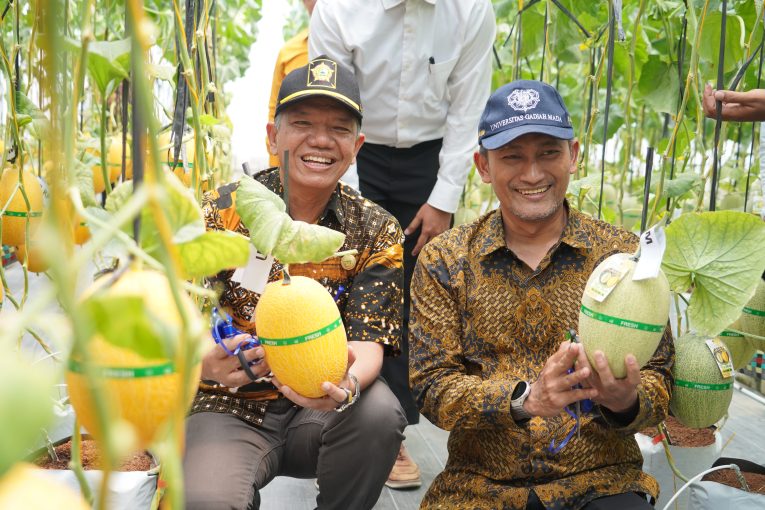
In the model farm developed through the Field Research Center (FRC) UGM Wates, research practices that directly impact society are beginning to show solid results, both in terms of productivity and land management efficiency. This was demonstrated through the large-scale harvest of greenhouse melons developed using the Farmer-Scale Appropriate Smart-Agri Facility/Fasilitas Smart-Agri Tepat Guna Skala Petani (FASTAN) technology, held on Friday, 30 January 2026, at FRC UGM Wates.
The harvest was attended by UGM Vice Rector for Planning, Assets, and Information Systems Arief Setiawan Budi Nugroho, S.T., M.Eng., Ph.D., Regent of Kulon Progo, Dr. R. Agung Setyawan, S.T., M.Sc., Dean of the Vocational School, Prof. Dr.-Ing. Ir. Agus Maryono, IPM., ASEAN Eng., Director of Research, Prof. Dr. Mirwan Ushada, S.T.P., M.App.Life.Sc., and Head of the Regional Development Planning, Research, and Innovation Agency (Bapperida) of Kulon Progo, Muh. Aris Nugroho, S.T., M.T.

This harvest was not merely a symbolic event, but rather the outcome of a series of applied research activities and field trials conducted over the past several years. Through FRC Wates, UGM researchers, together with regional partners and assisted farmer groups, have developed and tested various precise agriculture approaches tailored to the agroclimatic conditions of Kulon Progo.
Head of the FASTAN Research Team, Dr. Eng. Yosephus Ardean Kurnianto Prayitno, S.T., M.Eng., explained that the approach does not focus solely on technology, but also on building a sustainable relationship between research and cultivation practices within farming communities. Yosephus noted that the FASTAN system is designed to integrate environmental data and crop conditions so that cultivation decisions can be made more quickly and accurately by farmers themselves, without relying merely on estimation.
One of the advantages observed during the FASTAN field trials is the consistent sweetness level of the melons, reaching approximately 13.5 Brix. This indicates that the fruit quality remains stable, even when compared to conventional cultivation practices. Such a sweetness level is an important market indicator, as it influences consumer preference and the commodity’s market value.
The implementation of this system in the model farm shows that the use of data in cultivation processes has a direct impact on harvest outcomes. Farmers are able to optimize input usage, reduce potential risks, and maintain consistent harvest quality between each planting cycle. This serves as evidence that technology developed through research can be practically implemented and generate real impact at the farmer level.

The success of this harvest cannot be separated from the research ecosystem that supports its development. The Directorate of Research UGM plays a role in maintaining research continuity through program facilitation and cross-disciplinary coordination, enabling technological development at FRC Wates to proceed in an integrated and sustainable manner. Collaboration with the Kulon Progo Regency Government is also a crucial element in ensuring that research outcomes and field practices are connected to regional agricultural development programs. Through this synergy, the smart farming practices tested at FRC Wates have the potential to be replicated and expanded more widely among farmers.
The harvest held in Kulon Progo demonstrates that the development of smart agriculture requires a consistent and long-term process. From field research and technological implementation to actual harvest results, the collaboration at FRC Wates illustrates how research developed by UGM researchers can support a more adaptive and sustainable agricultural transformation.